


Last week was action-packed, to say the least. From key earnings reports to black swan events, many catalysts moved markets and opened new investment opportunities…
We at Aria Research have compiled a group of key catalysts this week. Citing what actually happened, the key hidden details, and what this means for your money. So without further ado, let’s begin…
Nvidia:
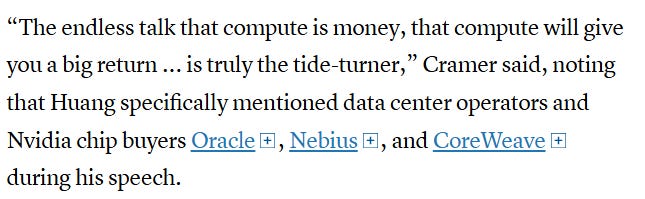
NVIDIA kicked off this action-packed week with their keynote speech at Computex 2026. Jensen Huang gave some key insights into the AI trade, boosting specific companies throughout the speech. Take NBIS, for instance. He referred to them as a “world-class AI cloud company,” noting that they are growing extremely fast. Because of this comment, Nebius proceeded to pop 14% on Tuesday, while being up 176% YTD. Marvell also sustained some intense upward pressure after Jensen called them the next “1 trillion dollar company.” Marvell moved 30%+ after the presentation.
Source: CNBC
During the keynote, Jensen kept mentioning that “Compute is revenue.” Now, if you are familiar with our stance here at Aria Research, we are a firm believer in the “capacity constraint moat.” Jensen essentially reiterated what we have been stating for a while. The demand for capacity will be eating up any new energy that comes online for the coming years, with interconnection queues taking 54 months on average. The most qualified and knowledgeable man in the AI space stated that the most scarce product on the market equates to revenue for the masses. Essentially, the companies that can offer quick “time-to-compute” and “compute capacity” will be the winners in this space. If you haven’t yet, please go read the research paper we wrote regarding Iren and Nebius. We explain in great detail the strategic positioning these companies have to gain exponentially from the capacity-constrained environment.
Source: NVIDIA.com
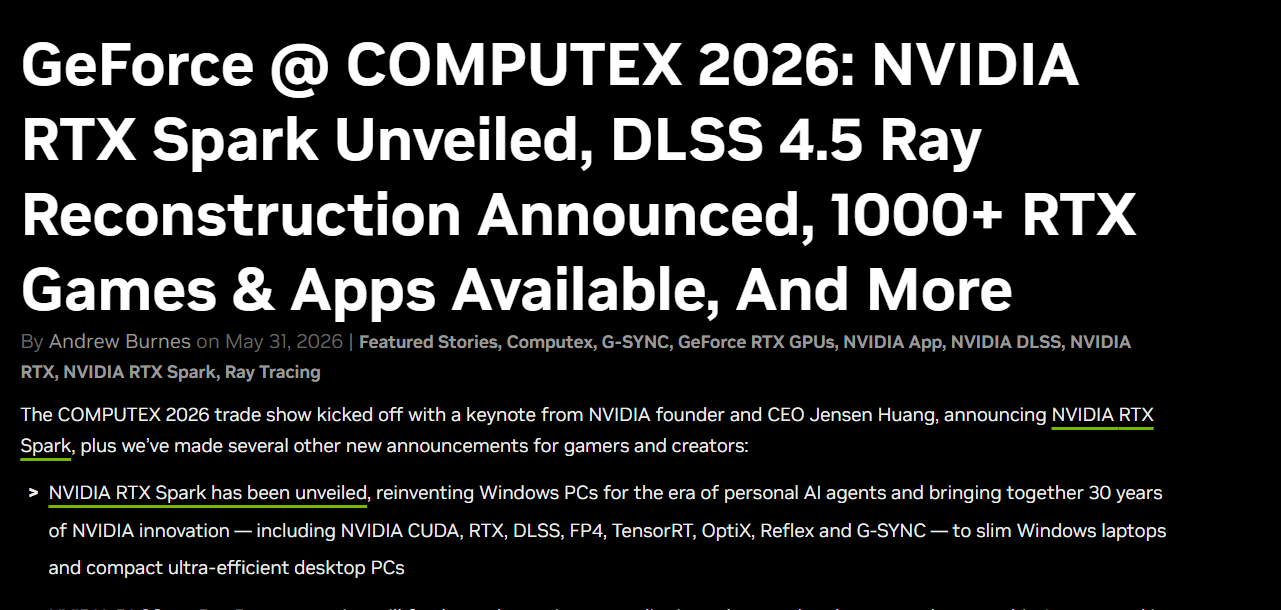
NVIDIA also revealed their RTX Spark Superchip, partnered with Microsoft on ARM architecture. This is a direct shot at AMD, INTC, and Qualcomm, attempting to take market share within the consumer computer sector. One thing Aria flagged that we find interesting is that NVIDIA is dipping their toes in every layer of the AI stack. NVIDIA pushing ARM-based SoCs is a direct shot at x86. Thus, the reason why the three companies mentioned above traded downward after the keynote.
Broadcom:
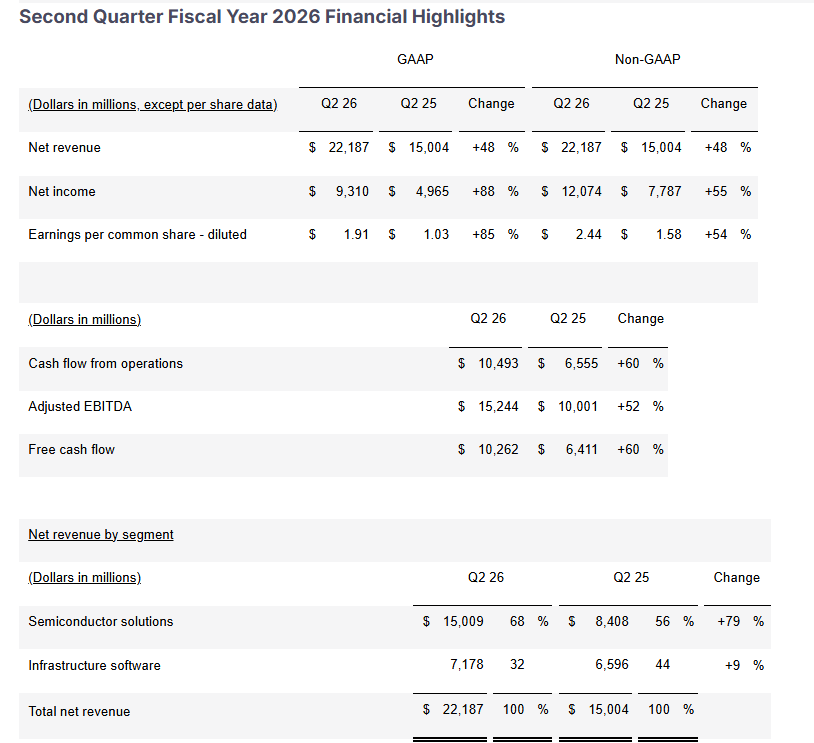
Broadcom, after hours on Thursday, released their Q2 2026 earnings report.
Source: Broadom Investor Relations
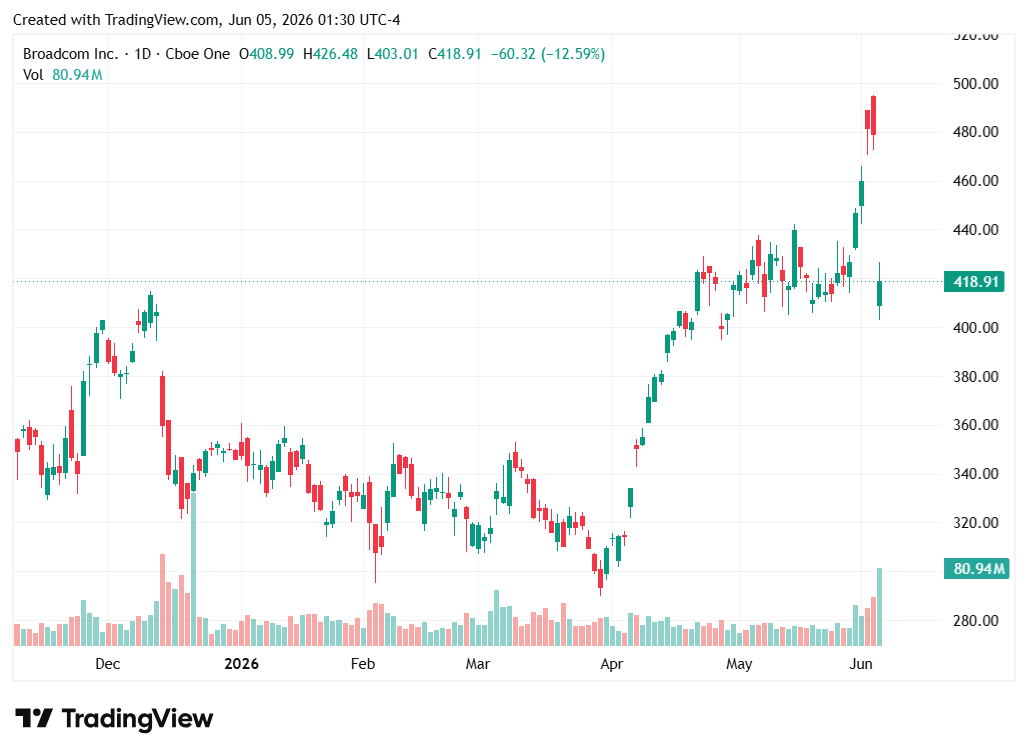
Q2 revenue $22.2B (+48% YoY); AI semi revenue $10.8B (+143% YoY); AI bookings topped $30B. Guided Q3 AI revenue to $16.0B, growth above 200% YoY. The stock printed a monster quarter, but future guidance failed to dazzle Wall Street, even though Q3 revenue guided 29.4B, above 28.5B. Also, fears arose surrounding Marvell and Media-Tek potentially taking market share of their TPU business. Thursday, Macquarie’s downgrade came from their modelling of Broadcom's share of Alphabet's TPU revenue falling from ~95% in 2026 to 80% in 2027 to 65% in 2028, as MediaTek and Marvell gain a role and Google develops in-house capability.
CEO Hock Tan also gave warnings surrounding their margins. Tan's point regarding margins was that segment margins remain very stable and very solid; it's the mix between software and non-AI versus the very rapidly growing AI semiconductor that's diluting gross margin. In other words, the weighted average falls purely because the lowest-margin bucket is becoming the biggest and fastest-growing slice of the pie.
This dilution is mechanical, not a demand signal. Margins aren't compressing because customers are paying less or pulling back; they're compressing because AI demand is so strong it's outgrowing every higher-margin line Broadcom has. If anything, the falling blended margin confirms the boom rather than warning of its end. What actually sold the stock off was a different set of fears: a reaffirmed-but-not-raised full-year AI target into a stock already priced for a raise, and a Google supply chain that's no longer Broadcom's alone. At Aria Research, we’ve modelled demand to keep booming until at least 2029 as a base case, with the bull cases exceeding 2030 onwards. The data backs up demand only accelerating, not softening, which is why we called this a textbook “buy the dip” opportunity on Thursday.
Intel:
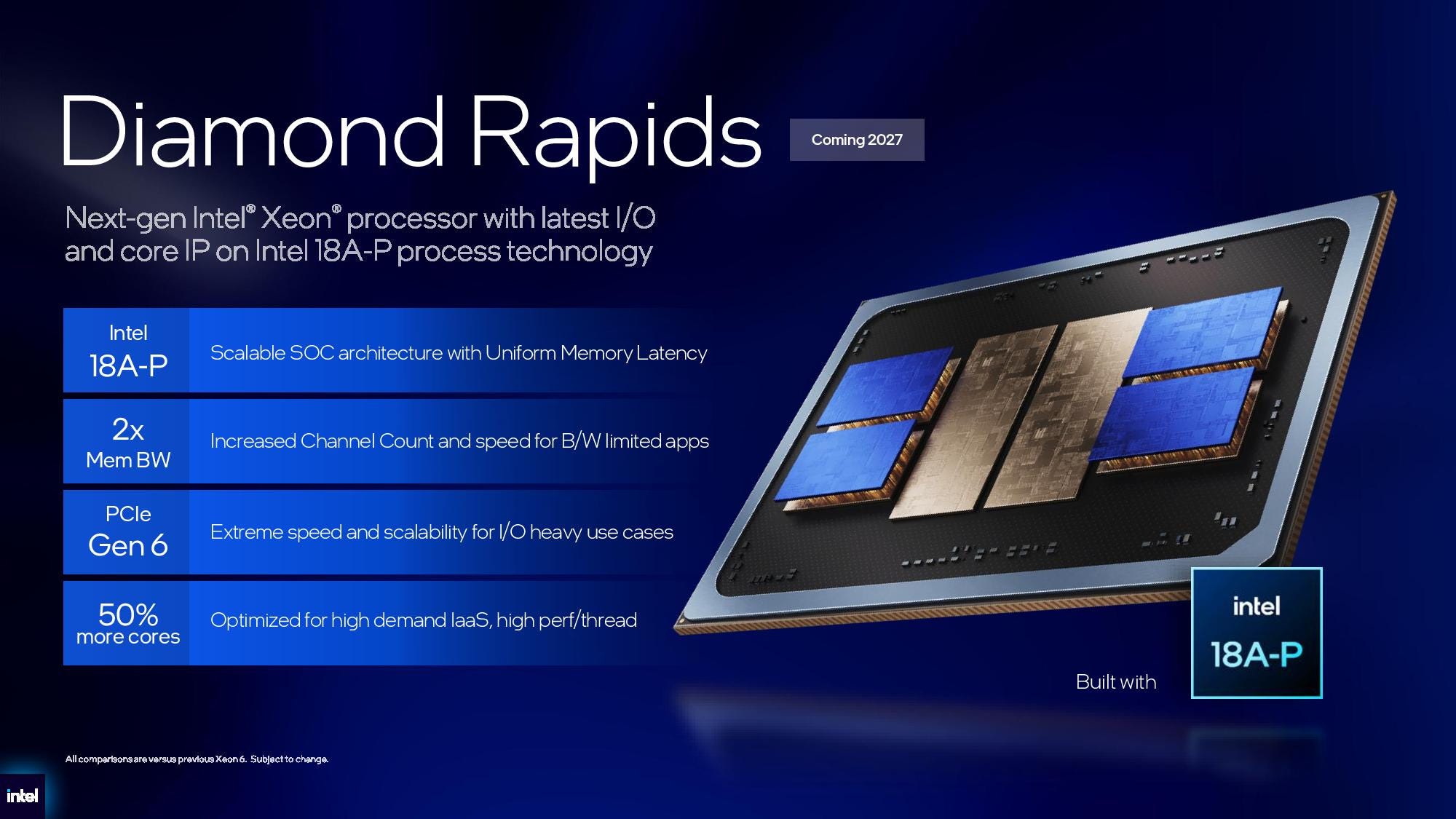
Intel kicked off their action-packed week with their Keynote speech at Computex 2026. Firstly, Intel confirmed their next-gen Xeon 7 chip, “Diamond Rapids,” to be manufactured on their 18A-P node in 2027, which is extremely positive. Many analysts have written about Intel having their yields at 50%, raising heavy issues regarding the future of its foundry. CEO Tan has consistently reiterated that they are increasing yields at 6-8% per month, and their Diamond Rapids chip got rid of any worries regarding yields and future node capabilities, in our opinion.
Source: Intel.com
Intel also leaned heavily on the “AI-everywhere story,” reiterating x86’s deep legacy as the architecture leader, as well as the CPU revival story. Intel presented a live demo of inference requests on a program, showing that the GPU/CPU ratio could reach 1:1, as agentic AI scales and becomes more prominent. Intel had left out any key information regarding their foundry, which is what investors care about most. At Aria Research, we believe more deals are inevitable for Intel’s foundry, as it is extremely bottlenecked. Due to the lack of “foundry talk,” Intel stock saw a pullback.
The Great Market Crash of June 5th 2026:
If you wanted to do some red light therapy, looking at the stock market on Friday last week was the best way to do it. The QQQ was down -4%, the S&P 500 dropped around -2.6%, resulting in 1.5 trillion dollars being wiped from the stock market. This was the first losing week in 10, and the biggest drop since October 10th. The trigger? The labour market, and SpaceX ipo.
Employers added 172,000 jobs in May, more than double the estimate of 80,000. The reason this killed markets is that it got rid of any potential for a rate cut. When the labour market is running really hot, it leads to more money circulating in the economy, resulting in more consumer spending (demand), increasing prices… or, in layman’s terms, inflation. Investors hate inflation, and the only way to combat it is to raise rates. The expectations for a rate hike rose to 66% on Polymarket. This is so pivotal for the AI trade because companies are borrowing a large amount of money for expansion, and when rates increase, it artificially cools growth and the economy. This spooked investors and made them sell out of stocks at an alarming rate. Great companies that we’ve flagged dropped 10%+, such as AMD, INTC, NBIS, IREN, and MRVL.
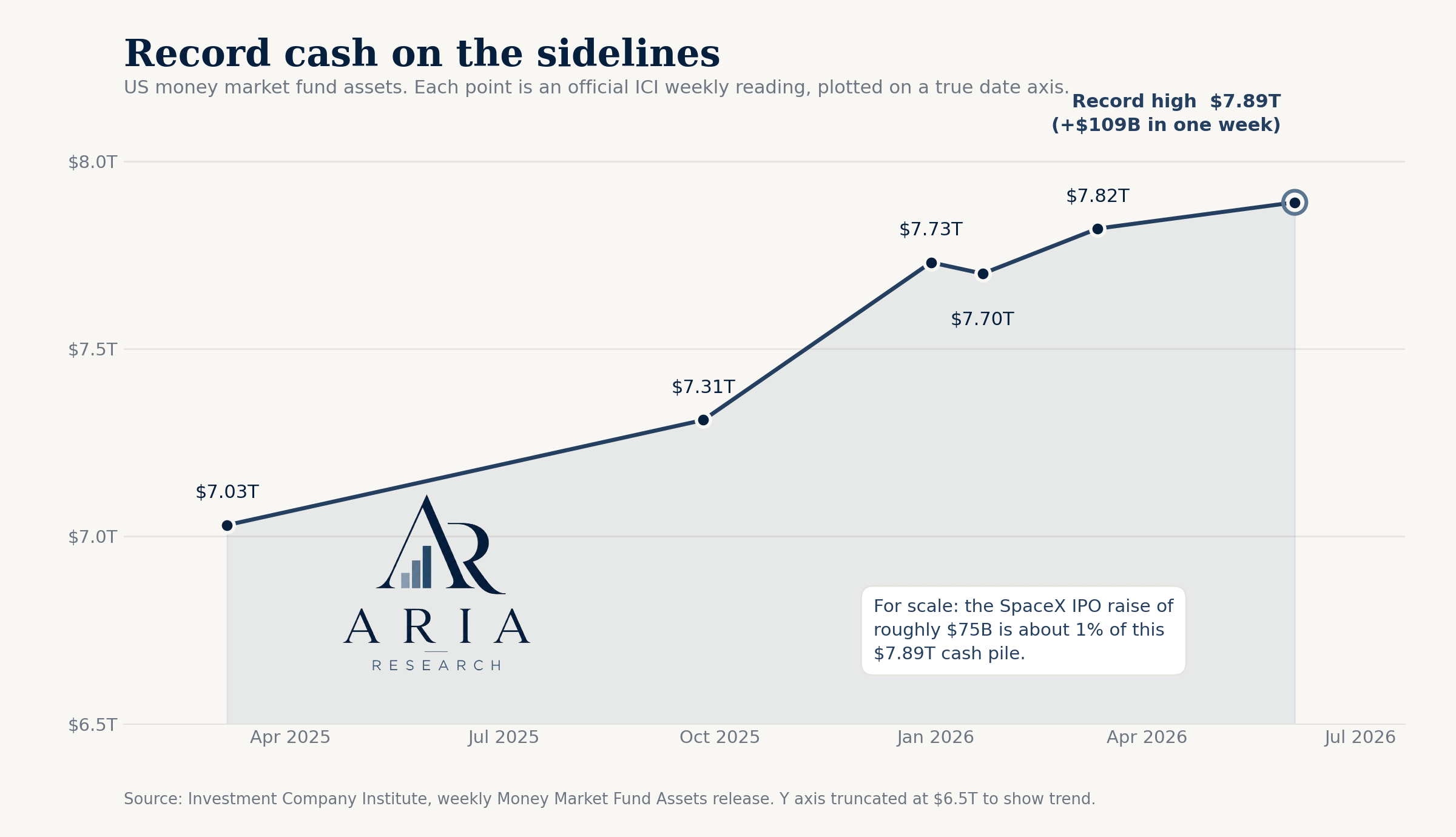
An important part of this sell-off was the SpaceX ipo. We saw a lot of money flow out of the stock market and into T-bills and sidelined cash. This is extremely important as no money flowed into precious metals like gold and silver. When money flows into gold and silver, this means institutions believe that a recession or large-scale crash is coming. Since this didn’t happen, we can rest assured this was more of a “one-off-flash crash.” The largest IPO ever is occurring on Friday, June 12th, offering at $135 per share, and a 1.77 trillion market cap.
A “once-in-a-decade” offering can make any investor pull sidelined cash and invest in it, and SpaceX is exactly that. When money moves into cash/cash equivalents, it means people are most likely preparing to unleash it. And the timing makes perfect sense. The “dry powder” is unambiguously there, the largest ever, and the SpaceX raise is trivially small against it, so a relief rally is well within the realm of what this cash could fund. What the data does not show is that the cash is already turning over. What this means is that a solid SpaceX IPO could be the trigger for a relief rally in hardware stocks in particular.
Below is a chart showing the amount of sidelined cash and comparing SpaceX's funding against the total cash value. (Split roughly 3 trillion in retail, and the rest institutional)
How to Strategically Play the Upcoming Weeks:
Encompassing everything that occurred, we have learned a few things that need to be addressed, so that we can make informed investment decisions…
