


Introduction
Quantum computing for decades was just a thought experiment; in the 18 months preceding this article, it evolved into something tangible; an engineering program with verified results, peer-reviewed studies, and 10s of billions of public and private capital flowing into this new scientific breakthrough.
However, there is a high amount of confusion regarding what quantum computing actually is and also what industries it can benefit in the future. So in this thesis, we will break down what Quantum Computing actually is, the current trajectory of the sector, and how it all ties in with the current investment landscape surrounding it.
Pillar 1: Science of Quantum Computing
The science of Quantum Computing is extremely complex, and this would turn into a 1000-page textbook if I explained every detail, so I will provide a simplified explanation of the basic principles of Quantum Computing that will become relevant in later parts of the thesis.
Classical Computers store information in bits, which can hold a state of either 0 or 1. Every program ever made runs on this framework. Quantum Computing replaces bits with Qubits, these Qubits can occupy the state of 0 and 1 simultaneously, which are described by two numbers called amplitudes and this state is called superposition. This is the foundation on which all the power of Quantum Computing lies, as it simply allows for an exponentially higher level of computing compared to classical computers for certain specialized tasks.
However, since these qubits exist at the microscopic level, they are incredibly sensitive to the environment around them. Things like temperature changes, vibration, or electromagnetic radiation can scramble their state and result in errors far more often than any typical transistor. The solution to this is Quantum error correction (QEC), combining Logical qubits and Physical qubits to counteract errors from destroying the original encoded data. But how does it do that?
Logical qubits are the software-defined unit of data, and Physical qubits are the physical hardware pieces (like trapped ions or photons) that exist in the processor but are also highly sensitive, as stated. So the single logical qubit encodes its information to many different physical qubits so that if one goes out of whack, the system can recognize and correct the one qubit’s error without having to destroy the original data. A good analogy takes us back to the medieval times, when there was no email, so all messages had to be delivered face to face, but entrusting just one person to travel great distances, kingdom to kingdom, delivering a message was risky because if something happened to them, then the entire message chain collapsed. What they would do is send 10 different people off to deliver the same message to lower the risk of a complete failure. Quantum computing leverages the same principle, encoding the data amongst many different physical qubits so that if one strays, it is easy to correct that error without risking the entire piece of data being lost.
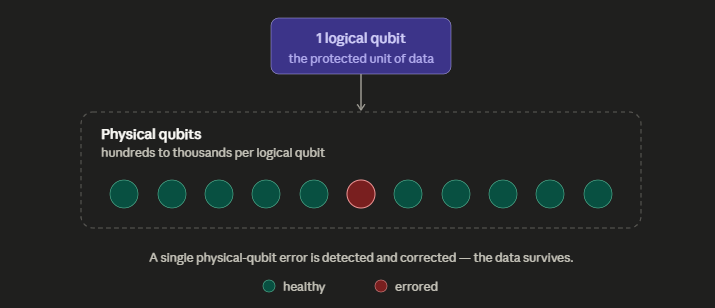
In Quantum computers, each logical qubit requires hundreds to thousands of physical qubits to ensure widespread errors are not a concern. Although this protection mechanism is also the #1 reason behind Quantum Computing’s limitations, the scale needed to minimize errors is huge!
Pillar 2: The Quantum Computing Frontrunners
Now that we have the basic understanding of Quantum computing under our belt, we can get into the fun parts, the companies that are on the front lines of this new emerging technology.
They are separated into 2 distinct categories: The Pure Plays (companies whose entire company is quantum) and the Tech Giants (companies that are cash-rich with great underlying business who are also pursuing Quantum). Let’s start with the Pure Plays.
Pure Players: IonQ, Rigetti, D-Wave, Quantinuum, PsiQuantum
IonQ (NYSE: IONQ) is the largest pure-play by revenue and the first to go public. Its trapped-ion systems reported a record 99.99 percent two-qubit gate fidelity in 2025, and the company has assembled an aggressive roadmap, targeting 10,000 physical qubits by 2027 (following its purchase of Oxford Ionics) and two million physical qubits by 2030. IonQ’s 2025 acquisitions (Oxford Ionics, Lightsynq, Capella Space, Vector Atomic, a majority stake in ID Quantique, and a pending SkyWater foundry deal) extend it into quantum networking, sensing, and security as well as computing.
Rigetti Computing (Nasdaq: RGTI) pursues a vertically integrated, modular superconducting strategy, assembling larger processors from 9-qubit chiplets in its own Fab-1 facility. Its 108-qubit Cepheus-1 system reached general availability in early 2026 at roughly 99 percent median two-qubit fidelity, and its roadmap targets 150-plus qubits in 2026 and 1,000-plus qubits by the end of 2027 at progressively higher fidelity. Rigetti also supports NVIDIA’s NVQLink platform for tying quantum hardware to AI supercomputers, something we will touch on again later.
D-Wave Quantum (NYSE: QBTS) is the commercial veteran of quantum annealing, a specialized approach aimed at optimization rather than universal computing. Its Advantage2 system, delivered through the Leap cloud, underpins real customer deployments, and its 2025 revenue grew 179 percent to roughly $24.6 million at an unusually high gross margin. In 2026 D-Wave also unveiled a gate-model roadmap targeting 100 logical qubits by 2032, signalling a move toward universal computing.
Quantinuum — formed from Honeywell Quantum Solutions and Cambridge Quantum — is the most valuable specialist, reaching roughly a $10 billion valuation in 2025 and filing to go public, with a Nasdaq listing expected in 2026. Its trapped-ion systems are widely regarded as best-in-class on fidelity.
PsiQuantum, still private at a roughly $7 billion valuation after a 2025 round backed by BlackRock, Temasek, Baillie Gifford, and NVIDIA’s venture arm, is making the boldest single bet: skipping the NISQ era to build a fault-tolerant, million-qubit photonic machine using silicon-photonic fabrication with GlobalFoundries, targeted before the end of the decade.
The Tech Giants: IBM, GOOGLE, Microsoft, Amazon
IBM: IBM has published the field’s most detailed and most consistently executed roadmap. At its November 2025 Quantum Developer Conference, it introduced Nighthawk, a 120-qubit processor with 218 next-generation tunable couplers that allows circuits with about 30 percent more complexity than its prior Heron chip and supports up to 5,000 two-qubit gates. IBM projects Nighthawk-class systems reaching 7,500 gates by the end of 2026, 10,000 in 2027, and as many as 15,000 two-qubit gates across 1,000-plus connected qubits by 2028. Alongside it, the experimental Loon processor demonstrated, for the first time in IBM’s line, all the hardware components it considers necessary for fault-tolerant error correction, and the company reported a tenfold speed-up in QEC decoding, a year ahead of schedule, and a shift to 300-millimetre wafer fabrication to double the development pace.
IBM’s stated targets are community-verified quantum advantage by the end of 2026 and fault-tolerant quantum computing by 2029, supported by its Qiskit software stack and a hybrid model that couples classical high-performance computing (CPUs and GPUs) with quantum processors (QPUs). Among incumbents, IBM also has the deepest enterprise-sales motion, which matters more than raw qubit counts for near-term revenue.
Google: Google Quantum AI’s 105-qubit Willow processor produced the field’s defining 2025 result: the first verifiable quantum advantage, using the Quantum Echoes algorithm built on out-of-time-order correlators, published in Nature and estimated at roughly 13,000 times faster than the best classical method for the task. The word verifiable is doing important work: unlike Google’s contested 2019 “quantum supremacy” claim, the 2025 result is reproducible and connects to a real scientific task, measuring molecular structure via nuclear magnetic resonance, which is why it drew broad, if cautious, validation. Google is careful to note this is a specialized tool, not a general-purpose quantum computer.
Microsoft: Microsoft is pursuing the highest-risk, highest-reward path. Its February 2025 Majorana 1 chip is built on topological qubits, which aim to protect quantum information in the hardware itself and, Microsoft argues, could eventually scale toward a million qubits. The science, however, is contested: independent physicists have questioned whether Microsoft’s claims are actually scientifically possible, and rival executives have publicly doubted the result. If Microsoft is right, it could leapfrog the field; if wrong, it has spent years on an unproven foundation. A reader should treat topological qubits as a genuine option, not an established one.
Amazon: Amazon, through AWS, took a more incremental route with its February 2025 Ocelot chip, which combines “cat qubit” technology with conventional error correction in a design that AWS says could substantially reduce the resources needed for error correction and shorten the path to a practical machine by up to five years. Amazon’s commercial center of gravity, though, is its Braket cloud service, which resells access to many hardware partners, a strategy that earns revenue regardless of which modality ultimately wins.
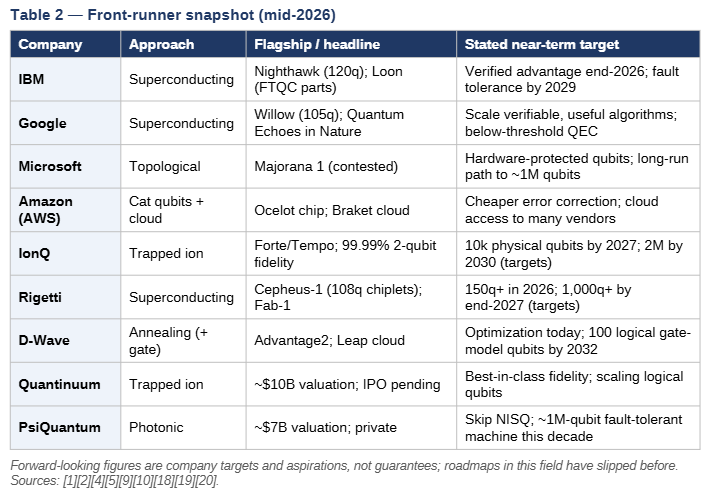
Source: Aria Research
Pillar 3: Use cases, AI + Data Center infrastructure, Quantum Realities
Quantum computing offers an exceptional advantage for certain specialized tasks and no advantage for others. What tasks will Quantum computing actually be useful for? Let’s dive in…
