


July 2026 has been one of the worst months I have witnessed. High-beta tech stocks have been getting slaughtered, with the majority of names falling 50% from highs. The weirdest aspect is that nothing fundamentally changed for these names. If anything, the thesis only grew stronger. In this article, I will put forth an evidence-based thesis as to why the bottom is most likely in, and the AI rally is just days away.
Debt Leverage Unwind:
A crowded trade coupled with over-leveraging is a recipe for disaster. Stocks don’t go down 50% from highs when nothing changes fundamentally. If I had to guess, more than half of the selloff was mechanical-based.
Source: JP Morgan
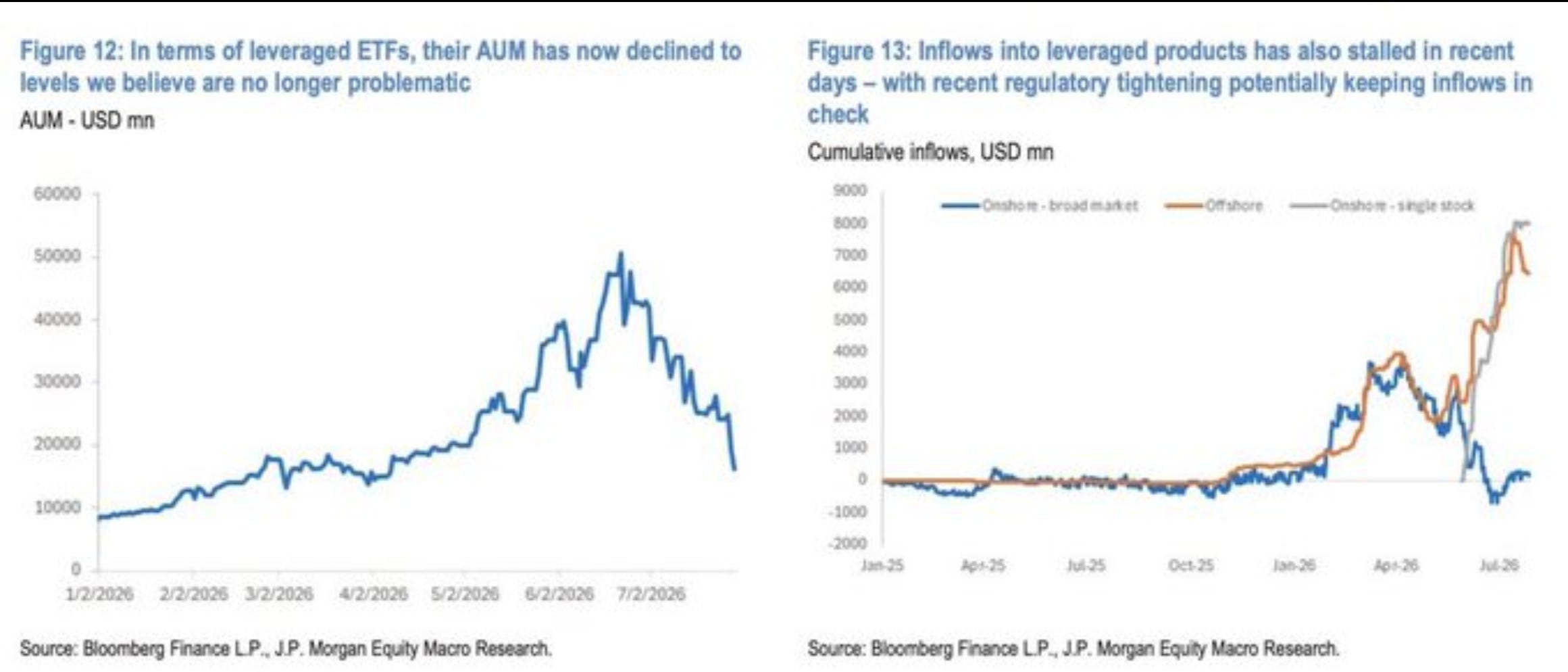
The graph on the left showcases the amount of money flowing into leveraged ETF’s. As we can see, the amount of leverage had peaked in late June/early July. It took roughly 6 months for the leveraged-AUM to reach $50 billion USD. Almost all of that leverage was unwound within the month of July, falling from $50 billion to roughly $15 billion. The concentration of leverage was overly invested into the AI sector. Take Korea as an example. As of this week, reports circulated that 3.4% of the adult population in Korea was margin called, with a fraction of them being fully liquidated. More than 50% of the Korean KOSPI index is composed of SK Hynix and Samsung, two of the largest suppliers of memory. Margin inherently amplifies bear markets, and the data completely justifies the “mechanical selling thesis” that occurred in July. For $35 billion worth of leverage to be unwound in 1 month means that massive margin calls occurred.
Take the news regarding Situational Awareness as an example. Reports came out that Leopold Aschenbrenner’s fund was forced into liquidation as a result of the July crash. Peaking with $45 billion worth of AUM, Situational Awareness was heavily invested in Neoclouds and power providers.
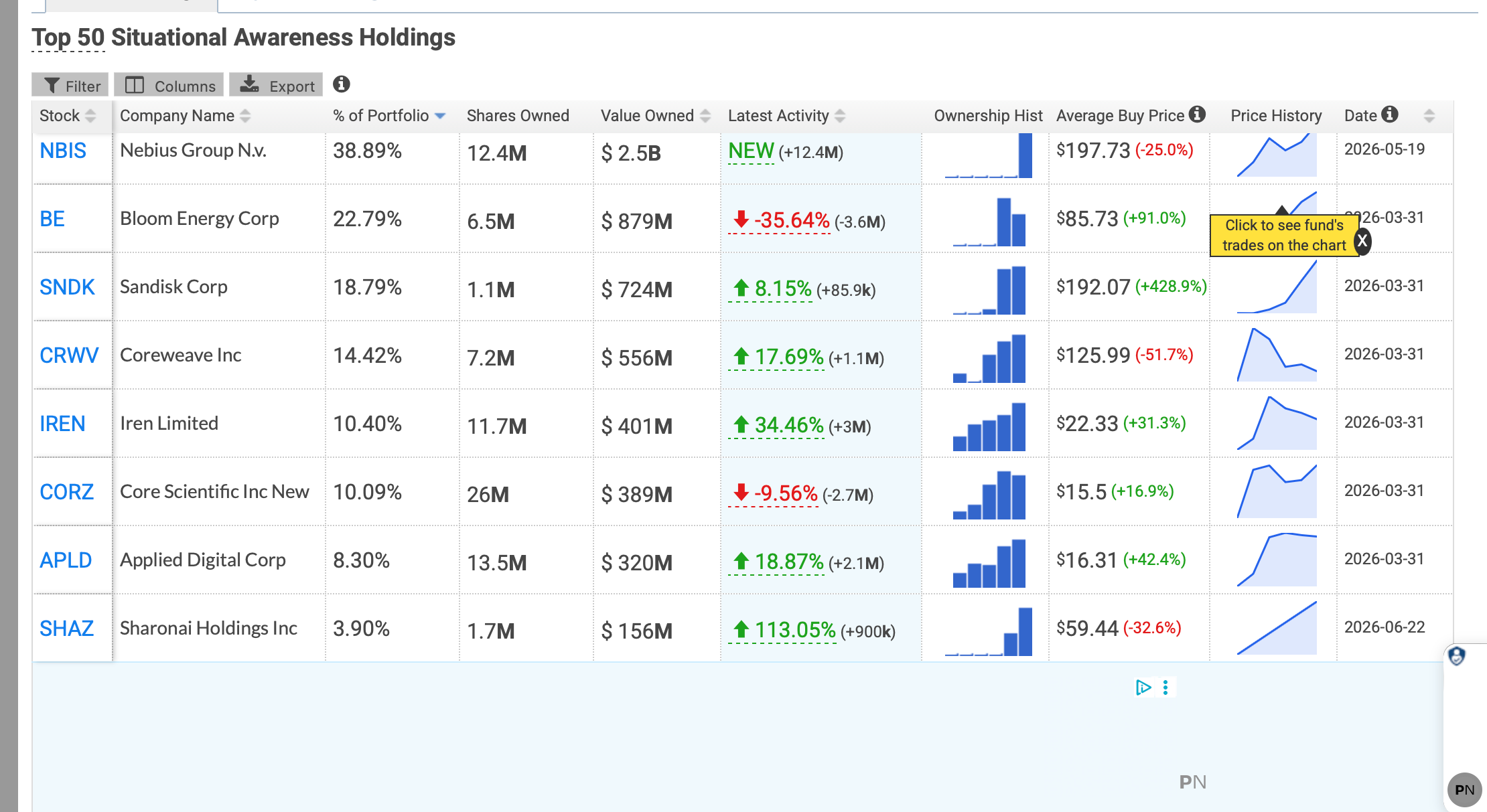
Fellow hedge funds and institutions realized the leverage issue occurring and proceeded to short the stocks that rallied the hardest. Sadly, the majority of those stocks are held by retail investors and smaller funds like Situational Awareness. As a result, Leopold’s assets were purchased by Citadel for an undisclosed amount.
The chart on the right measures the flow of money into the leveraged equities. Between July 15 and July 22, the KOSPI market had tanked significantly; during this time, JP Morgan cited roughly $8-$9 billion in new money went into those leveraged products. Only in the past two weeks did they start seeing net outflows, of about $2 billion. The sequence is as follows: The markets would dip, retail would lever up and purchase more, prices dip further, the new leverage gets destroyed, then people finally start pulling money out, amplifying the downturn. This chart showcases that the leverage issue is nearing its end. JP Morgan's latest read is that the “leveraged ETF unwind is 100% complete, hedge fund deleveraging is about 90% done, retail margin balances are declining moderately, and passive foreign selling has eased considerably.” As a result, JP Morgan states that the leverage AUM is “no longer problematic.”
The Bottom is In:
The mechanical forced selling is more or less coming to an end. Leopold’s liquidation is the evidence. Think of liquidation as a queue. The traders able to withstand the longest are at the end of the queue, with the most exposed going first. Take the Koreans as an example. Roughly 1.2 million Koreans were margin called because they were investing on borrowed money; in this instance, they could not resist, and brokerages liquidated immediately. The last to go are always the public funds like Situational Awareness. Like these funds, Leopold had many bargaining chips: three prime brokers to negotiate with, collateral to post, private assets to sell, and investors to call. He tried all of it. Talks with lenders, offered portfolio assets to individual investors, and sent a July 24 letter inviting fresh capital. Millennium and Jane Street both evaluated the positions and declined. The Korean unwind started June 22, meaning his fund lasted five and a half weeks.
It is rumoured that other investment firms were purposefully shorting the assets Situational Awareness was holding. Take the following letter Leopold sent to his investors as anecdotal evidence…
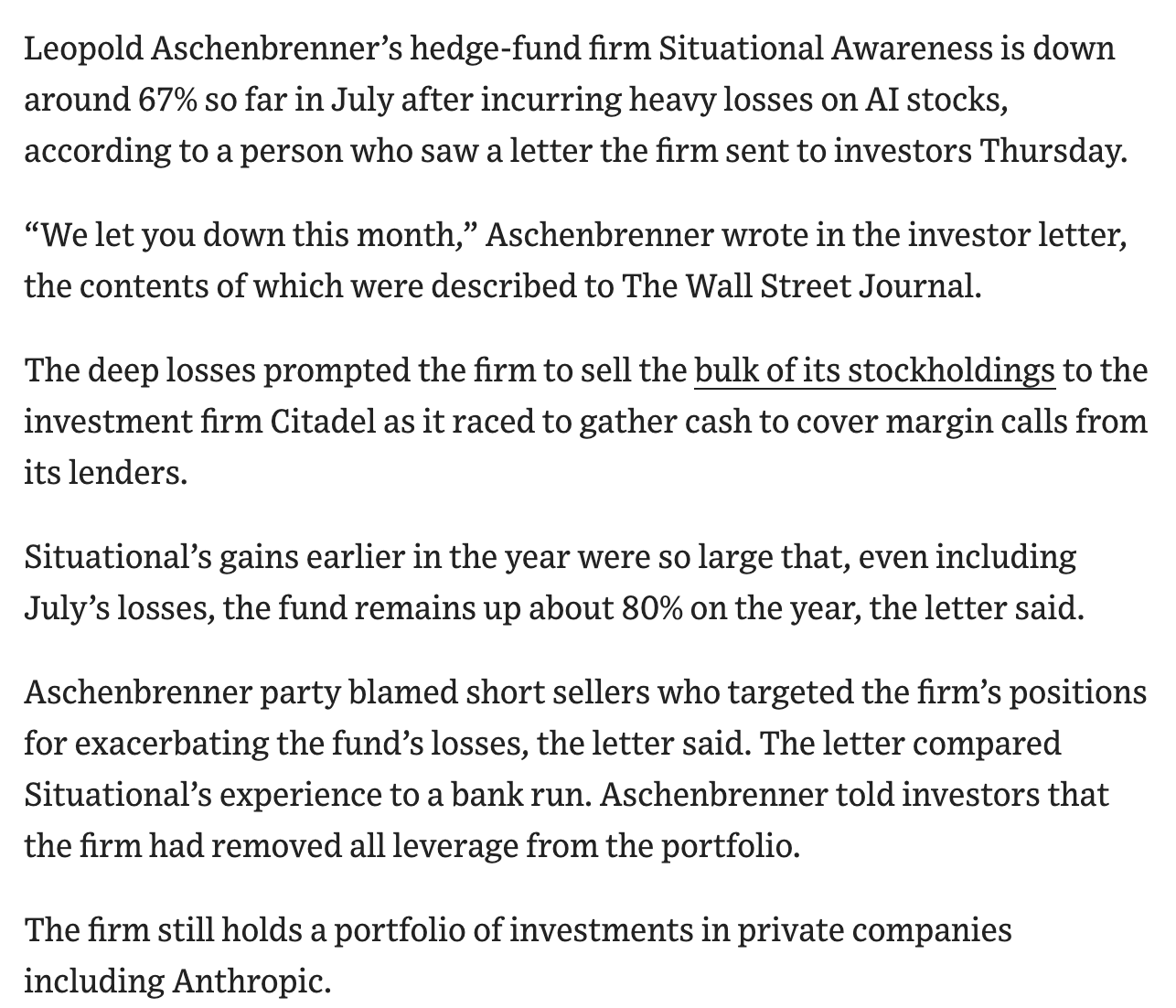
“Aschenbrenner’s party blamed short sellers who targeted the firm’s positions for exacerbating the fund’s losses.”
Martin Shkreli, speaking on TBPN, said: “funds were already shorting Situational Awareness's holdings as early as Monday in anticipation of the liquidation.” Once it hits the mainstream that a fund has to unwind positions, institutions DO NOT waste any time to position accordingly. Funds began selling all positions that overlapped with Leopold’s fund, while simultaneously shorting the rest. The reason that funds do this is because of how lucrative it is. Operating at 3-4x leverage, Situational Awareness was extremely exposed to market fluctuations. Funds shorting his positions are betting on his inevitable liquidation; sending his positions lower means they make money on the downside, and eventually can purchase his shares when they hit the open market for much cheaper, closing their positions with massive profits.
Shkreli put it very bluntly. He claimed that “Wall Street would happily send a name like Micron to $5 if the ruin it triggers is where the money is.” Some of the selling wasn't even hostile/targeted. If a fund owned CoreWeave and knew that a multi-billion dollar holder was about to be pushed out of it, you sold that morning rather than after the wave, and hundreds of funds running that same calculation at once create crushing pressure with nobody intentionally coordinating anything. Leopold went to his prime brokers to try and issue a sale of his book. According to Shkreli, word hit the Street a week before his liquidation. There was a big issue… Leopold couldn’t simply sell on the open market. A $2.6 billion stake in Nebius and $401 million dollars worth of Iren would be equivalent to weeks of those stocks’ daily trading volume. He would only be able to sell a small slice per day before he pushed the price down himself, artificially losing him money. The worst part is that massive sell orders give away your distress. Once buyers notice large selling volumes, they tend to step away and wait for lower prices, essentially evaporating liquidity he very much needed. Due to his leverage exposure, every 1% he knocked off of his positions from selling would hurt his margin cushion by 4%. Leopold was inevitably forced to sell his book to Citadel through prime brokers at around 0.40 cents on the dollar, as the opportunity cost was more attractive than slowly selling on the open market.
Looking at the facts, all of his positions were the ones that got hit the hardest during the July selloff. CoreWeave, Nebius, Intel, Iren, and Sanisk were amongst the biggest losers during July, all tumbling over 40%. Hindsight being 20/20 is an understatement; it is clear that Leopold’s liquidation was one of the major catalysts that unlawfully pushed the markets down further.
Stocks To Have On Your Watchlist:
The whole argument I’m presenting is that hardware stocks have been sold off asymmetrically to their fundamentals. The following companies are the most oversold with immense upside in my view.
Firstly, Intel Corp. Intel tumbled from $140 to $85 per share during July. Their foundry roadmap and general fundamentals have gotten much stronger over the course of the selloff, with more companies showing interest in their EMIB technology and advanced process nodes.
